



The Best Server CPUs part 2: the Intel "Nehalem" Xeon X5570
by Johan De Gelas on March 30, 2009 3:00 PM EST- Posted in
- IT Computing
| Collaboration and infrastructure software: MS Exchange 2007 | |
| Operating System | Windows 2008 Enterprise RTM (64-bit) |
| Software | MS Exchange 2007 SP1 (64-bit) |
| Benchmark software | LoadGen 08.02.004 |
| Typical error margin | 1-2% |
Collaborative and infrastructure servers are good for about 50% of the server market. Even if we subtract the fileservers and print servers (which rarely demand a lot of processing power), it is still the most important market for servers. Today we're introducing MS Exchange 2007 in our server CPU benchmark suite.
For our Exchange 2007 test we used Microsoft LoadGen in stress mode. This means instead of actually simulating a business day, LoadGen will fire as many actions at the server as it can handle for the specified duration of the test, which in our case is slightly more than 1 hour. We limited the mailbox for each of the 2000 users to 30MB instead of the default 750MB to reduce the load on our storage system. All users are logged on before the actual test started.
The LoadGen test results tend to vary wildly when you use the default settings. Even when we tested for 8 hours, the results were not within an acceptable margin of error. To remedy this, we limited the different actions to just SendMail, ReadAndProcessMessages, BrowseContacts, and BrowseCalendar. It is not perfect, but at least we get very repeatable results. As we are relative newbies when it comes to benchmarking the Exchange groupware, expect some improvements to this benchmark in the future.
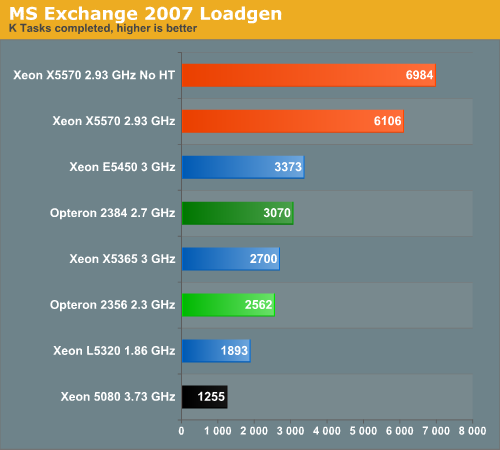
Our testing shows that the Opteron 2384 achieves the same initial throughput as the Xeon 5472, but for some reason the testing breaks off or slows down to an incredibly slow pace. That is why we cannot give you the final results right now; we'll update the results when we solve this problem. Nevertheless, there is little doubt in our minds that the newest Xeon X5570 is running circles around everyone else: it is capable of performing twice as many operations as its older brother.


 Facebook
 Twitter
 RSS
RSS


44 Comments
View All Comments
rkchary - Tuesday, June 16, 2009 - link
We've a customer who is interested in upgrading to Nehalem. He's running on Windows with Oracle database for SAP Enterprise Portals.Could you kindly let us know your recommendations please?
The approximate concurrent users would be around 3000 Portal users.
Keenly looking forward for your response and if you could state any instances of Nehalem installed in SAP environment for production usage, that would be a great deal of help.
Regards,
Chary
Adun - Thursday, April 9, 2009 - link
Hello,I understand the PHP not-enough-threads explanation as to why Dual X5570 doesn't scale up.
But, can anyone please explain why when you add another AMD Opteron 2384 the increase is from 42.9 to 63.9, while when you add another Xeon X5570 there isn't such an increase?
Thank you for the article,
Adun.
stimudent - Thursday, April 2, 2009 - link
Was it really too much effort to clean off the processor before posting a picture of it? Or were they trying to show that it was used, tested?LizVD - Friday, April 3, 2009 - link
Would you perhaps like us to draw a smiley face on it as well? ;-)GazzaF - Wednesday, April 1, 2009 - link
Well done on an excellent review using as many real-world tests as possible. The VMWare test is a real eye opener and shows how the 55xx can match double the number of CPUs from the last generation of Xeons *AND* crucially save $$$$ on licensing from Windows and MS SQL and other per-socket licensed software, plus the power saving which is again a financial saving if you hire rack space in a datacentre.I eagerly await your own in-house VM tests. Please consider also testing using Windows 2008 Hyper-V which I think doesn't have the 55xx optimisations that the latest release of VMWare has (and might not have until R2?).
Thanks for the time you put in to running the endless tests. The results make a brilliant business case for anyone wanting to upgrade their servers. You must have had the chips a good week before Intel officially launched them. :-) I do feel sorry for AMD though. I'm sure they have plenty of motivation to come back with a vengeance like they did a few years ago.
JohanAnandtech - Thursday, April 2, 2009 - link
Thanks! Good to hear from another professional. I believe the current Hyper Beta R2 already has some form of support for EPT.Our virtualization testing is well under way. I'll give an update soon on our blog page.
Lifted - Wednesday, April 1, 2009 - link
You mention octal servers from Sun and HP for VM's, but does anybody really use these systems for VM's? I can't imagine why anybody would, since you are paying a serious premium for 8 sockets vs. 2 x 4 socket servers, or even 4 x 2 socket servers. Then the redundancy options are much lower when running only a few 8 socket servers vs many 2 or 4 socket servers when utilizing v-motion, and the expansion options are obviously far less w/ NIC's and HBA's. From what I've seen, most 8 socket systems are for DB's.Veteran - Wednesday, April 1, 2009 - link
What i mentioned after reading the review is there are very few benches on benchmarks a little bit favored by AMD.For example, only 1 3DSmax test (so unusefull) at least 2 are needed
Only 1 virtualization benchmark, which is really a shame....
Virtualization is becoming so important and you guys only throw in one test?
Besides that, the review feels a bit biased towards intel, but i will check some other reviews of the xeon 5570
duploxxx - Wednesday, April 1, 2009 - link
Virtualization benchmark come from the official Vmmark scores.However there is something real strange going on in the results...
HP HP ProLiant DL370 G6
VMware ESX Build #148783 VMmark v1.1
23.96@16tiles
View Disclosure 2 sockets
8 total cores
16 total threads 03/30/09
Dell Dell PowerEdge R710
VMware ESX Build #150817 VMmark v1.1
23.55@16tiles
View Disclosure 2 sockets
8 total cores
16 total threads 03/30/09
Inspur Inspur NF5280
VMware ESX Build #148592 VMmark v1.1
23.45@17tiles
View Disclosure 2 sockets
8 total cores
16 total threads 03/30/09
Intel Intel Supermicro 6026-NTR+
VMware ESX v3.5.0 Update 4 VMmark v1.1
14.22@10 tiles
View Disclosure 2 sockets
8 total cores
16 total threads 03/30/09
So lets see all the prebuilds of esx3.5 update 4 get a real high score of 16 tiles almost as much as a 4s shanghai while Vmware performance team themselves stated that we should never see the HT core as a real cpu in Vmware (even with the new code for HT) while yet the benchmark shows a high performance increase, no not like anandtech is stating that this is due to the more available memory and its bandwith, those Vmmarks are not memory starving. Now look at the official Intel benchmark with ESX update 4, it provides 10 tiles and a healthy increase, that from a technical point of view seems much more realistic. All other marketing stuff like switching time etc, all nice, but then again is within the same line of current shanghai.
JohanAnandtech - Wednesday, April 1, 2009 - link
What kind of tests are you looking for? The techreport guys have a lot of HPC tests, we are focusing on the business apps."very few benches on benchmarks a little bit favored by AMD."
That is a really weird statement. First of all, what is a test favored by AMD?
Secondly, this new kind of testing with OLTP/OLAP testing was introduced in the Shanghai review. And it really showed IMHO that there was a completely wrong perception about harpertown vs Shanghai. Because Shanghai won in the tests that mattered the most to the market. While many tests (inclusive those of Intels) were emphasizing purely CPU intensive stuff like Blackscholes, rendering and HPC tests. But that is a very small percentage of the market, and that created the impression that Intel was on average faster, but that was absolutely not the case.
"Only 1 virtualization benchmark, which is really a shame..."
Repeat that again in a few weeks :-). We have just succesfully concluded our testing on Nehalem.
Personally I am a bit shocked about the "not enough tests" :-). Because any professional knows how hard these OLTP/OLAP tests are to set up and how much time they take. But they might not appeal to the enthousiast, I am not sure.